


Favorite Posts
Favorite Links
Savvy Vegetarian Blog
news and opinion on vegetarian diet and nutrition, vegetarian lifestyle, green living, and environment
Got Something To Say? Tell Savvy Veg!
Sun, 09 Dec 2007
Word Of The Year 2007: Locavore!
From Union of Concerned Scientists 12/7/07 FEED newsletter.
O.K. I'll bite. What is a locavore??? At first glance, I thought the word was 'locovore' - a carnivore with mad cow disease maybe? Then in my dyslexic state I mispelled it as 'lovacore' - someone who lives on love? Finally I got it right. The New Oxford American Dictionary's 2007 Word of the Year is LOCAVORE, defined as 'a person who seeks out locally produced food'.
UCS tells us that the local foods movement is gaining momentum as people discover that the best-tasting and most sustainable choices are foods that are fresh, seasonal, and grown close to home. Amen! Some locavores draw inspiration from the 100-mile diet or from advocates of local eating like Barbara Kingsolver. Others just follow their taste buds to farmers' markets, community supported agriculture programs, and community gardens.
Savvy Veg notes that UCS doesn't mention your own back yard as a source of locally grown food. However, if your thumb is even slightly green, and there's any way that you can grow things where you live - just do it!
A few of the many reasons why growing veggies is my favorite way to eat locally:
- Grow a lot of food in a little space from just a few little seeds. You can even buy food seeds & plants with food stamps!
- Turn your kitchen scraps into compost for your plants, and send less garbage to the landfill.
- It costs almost nothing to grow food, especially if you scrounge for free local materials and inputs.
- Gardening is a great way to get fresh air and exercise, save on gym fees, and escape doing the dishes.
- It's Cheap Therapy: You can't have a problem when you're digging in the dirt.
- Nothing, and I mean NOTHING, tastes as good as a veggie you just harvested from your own garden, even if your garden is just a lone tomato plant on your apartment balcony
Check out Local Harvest to find sustainably grown food near you, and make a New Year's Resolution to become a Locavore in 2008!
permanent link to this entry
Mon, 03 Dec 2007
Allena Tapia from Diet Detective just wrote to tell me she linked to my 'awesome site' (that would be Savvy Veg). Curiosity led me to her awesome site.
Although Allena says that she's a 'transitional vegetarian' according to Savvy Veg, Diet Detective is an excellent resource for vegetarians or anyone in healthy lifestyle and weight loss. The section that I'm really excited about is one of the best food resources I've seen online: the Food Search Section of Diet Detective. This is a thorough nutritional analysis of thousands of foods, including most everything that vegetarians & vegans eat - exactly what I've been looking for. Even spices & herbs are listed, making it clear what nutrition powerhouses they are. For example, 1 tsp of cumin has 1% of the daily value of Vitamin A, 2% of calcium, and 7.9% of iron, plus trace amounts of Vitamins C, E & K, Thiamin, Niacin, Folate & B6. Who Knew!?
The Food Search section is a valuable tool for meal planning, weight loss, or weight gain for some lucky people! I plan to use it for developing recipes on Savvy Veg. In addition, Diet Detective offers a weight loss support group (membership is $49.95 per year), health & diet articles and advice, community forums, newsletter and more.
permanent link to this entry
Mon, 19 Nov 2007
Savvy Vegetarian is proud to host the 104th Carnival of the Green
COTG is a roving digest of the green blogosphere, managed by Treehugger. Carnival of the Green roams from blog to blog each week, offering entertaining and enlightening bits and bytes - with an ecopolitical-green-sustainable focus.
Last weeks Carnival of the Green was a No-Show. Next week's carnival is happening at Great Green Goods
Since this is the season of consumerism (aka holiday spirit), to which green people are not immune - we present sustainable green shopping opportunites. Sadly, global warming is still with us, but solar power and other alternative energy sources are on the rise.
Mindful Momma tells us why our next appliance purchase should be Energy Star Rated. My question is, why would anyone do otherwise?
Thoughts On Global Warming: Simmons writes about a solar powered mp4 player, which he describes as 'pretty sick'. For the un-hip among us, I think that means it's very very good.
Preston Koerner at Jetson Green posts about a modern, green, affordable ($100 K) house in Philadelphia. That pushes all my consumer buttons, except (whine) why isn't it in Florida?
OK, Here It is! Corbett Kroehler at Keyboard Culture talks about Florida's Showcase Green Envirohome, which embraces solar energy, and will even have a solar air conditioner! I wonder if its a $100K eco-house like the one in Philly. Just a thought.
Last week, Beth Terry at Fake Plastic Fish tried to post about finding plastic in places you might not expect, as in Evert Fresh 'green' bags, which have been advertised as un-plastic. This week Beth posts about toxic PVC lurking in your house and how to deal with it, plus her quest for the 'greenest' plastic-free cutting board. I want to know about that!
Eco Books For Today's Kids: MC Milker, The Not Quite Crunchy Parent, looks beyond eco friendly subjects in kid books to truly environmentally friendly kid books.
Nick Aster at Triple Pundit announces: Yokohama to Launch Tires Made of Orange Rinds.
Gourmet Coffee Reviews reports: Specialty Coffee Retailer Introduces ?Green Cup? Tully's, a handcrafted coffee roaster in Washington state, recently became the first major coffee retailer to adopt a fully renewable and compostable paper beverage cup. Tully's also has an in-store collection program to divert the used 'green' cups and other compostable food waste from local landfills to organic composting facilities. Go Tully's!
Coinciding with the seasonal consumer feeding frenzy, the Nov. 18th edition of E-Magazine's weekly Earth Talk column answers the question,'What are the best sources out there for environmentally friendly consumer products?' According to Earth Talk, online is one of the best bets. Savvy Vegetarian also has a list of favorite online green retailers and directories.
JP Davidson at Green Deals Daily tells us the Top 5 Ways to Convince People who Don't Give a Damn about the Environment - with varying degrees of success. Plus, tips for going green without spending a dime, AND how to get environmentally friendly products FREE. Living more sustainably has never been easier (or cheaper!)
Three Posts From Adam Williams at Life Goggles:
Recycline Preserve Razors
Adam's girlfriend, and friend Rob loved this recyclable razor.
The Fun Green Roundup #6
Salmon Sperm & LED's, Pandas & Bamboo, Green Faith, and Shower Shock.
The Green Wall of Shame: Naughty people, things
and places which are damaging the environment or seem against improving it.
Ken Philby's Top Tip: Get Over Yourself, Buy Used: Philby's Finance encourages us to buy used products whenever possible to save money and help the environment.
Posted by Peter Jones, Indigenous Issues Today: Biofuel and It's Non-sustainable Impacts: A Case from West Papua.
The Inspired Protagonist on Concentrated Solar Power: Inkslinger wants to know: If this technology can supply 90% of the world with 100% emissions-free electricity, why are we even talking about fossil fuels anymore? Good question!
Kevin Cawley posted Cure for Cancer Powers Engines, in which a medical researcher seeking a cure for cancer accidentally found a viable alternative energy source.
Ed Yong at Not Exactly Rocket Science explains how the deep soil contains a massive stable store of carbon, and it's important that agricultural practices don't disturb the soil to avoid stirring this 'sleeping giant'.
Veggie Revolution: What kind of forests absorb more carbon than any other? Read about the special ecosystems that could become important tools for stabilizing our climate.
Lisa Baker of The Christian Environmentalist posts about a project to build a cellulosic (pine wood chips) ethanol plant in Georgia, and the problems that need to be addressed before cellulosic ethanol can be environmentally feasible.
Melanie Rimmer at Bean Sprouts tells why the International Slow Food movement is an example of "foodies" and "greenies" being on the same side. I always suspected it was so. But wait. Does this mean that the slow foodies have resolved the eco-contradictions between eating meat and being green? Not quite...
So here we are - still stuck between our consumeristic tendencies, and our desire for a greener world. May we resolve the conundrum with grace and good cheer! Thanks for visiting Carnival of the Green! See you next week at Great Green Goods.
permanent link to this entry
Sun, 18 Nov 2007
Where To Find Earth Friendly Consumer Products
We're well into the seasonal consumer feeding frenzy, and green people are not immune. Just coincidentally, this week's Earth Talk column from E-Magazine answers the question, 'What are the best sources out there for environmentally friendly consumer products?' According to Earth Talk, online is one of the best bets, and Savvy Vegetarian agrees.
Earth Talk recommendations for green shopping:
Gaiam, which acquired Real Goods in 2000. They also have a print catalog, and partner with retail giants like Target for wider distribution of green goods.
Another good one-stop shop for green consumer goods is Green Home, which sells thousands of environmentally responsible home products online.
The best one-stop source for green building materials is Ecohaus (formerly the Environmental Home Center). The company has three stores in Portland and Bend, Oregon and Seattle, Washington.
For harder-to-find green goods, check out Ecoseek.net, which bills itself as 'the Internet's first green product search engine' with links and reviews for more than 6,500 different green products from over 300 merchants.
Another good online stop is EcoMall, which lists thousands of socially responsible manufacturers and distributors of just about every type of green product imaginable.
Here are just a few of Savvy Vegetarian's online eco-shopping favorites:
Aubrey Organics: Has been around longer than most, and is just what it claims to be - organic herbal body care products. Extensive online catalog, many more products than you ever see in stores. There's also a handy store locator on the site.
Abundant Earth: Catalog of goods-for-the environment made with organic and recycled materials - bedding, linens, furniture, rugs, cleaning supplies, air and & water purifiers, candles ...
Kush Tush: Healthy, eco-safe organic bedding and bath essentials, for natural protection from allergies, MCS, and SIDS. Complete Organic Baby Shop.
Nature's Crib: Natural and organic products for babies and parents, including organic baby clothing & bedding, natural baby care, cloth diapers, and cleaning products.
Green Elegance Weddings: Designed for the stylish couple who also wants to do the right thing for the planet, while at the same time bringing an atmosphere of elegance to their celebration.
Green Kits: Green-kits offers green cleaning products, reusable grocery bags, organic baby care, green product kits for kitchen, bath and baby, tips on why and how to green your home.
Organic Selections: Natural Selections website, a wonderful store in Fairfield IA, filled with beautiful, natural and organic products - clothing for the whole family, body care, gifts, furniture, bedding.
Mountain Rose Herbs has consistently delivered exceptional quality certified organic products with a strict emphasis on sustainable agriculture. Bulk organic herbs and spices, essential oils and herbal teas.
Happy Cow: Global, searchable vegetarian dining guide and directory of natural health food stores, including nutrition & health tips, vegan recipes, raw foods, travel, vegetarian issues.
Green People: Very Large Directory of eco-friendly and holistic health products: Organic food, pet supplies, baby products, beauty products, home improvement, hemp, organic cotton, health products, recycled products.
Eco Business Directory Organic food, solar energy, sustainable housing, organic cotton, vegetarian dating, organic farms, sustainable communities, eco products.
permanent link to this entry
Wed, 10 Oct 2007
2007 Blog Action Day Theme: The Environment
On October 15th, bloggers around the web will unite to put a single important issue on everyone's mind - the environment. Every blogger will post about the environment in their own way and relating to their own topic. The aim is to get everyone talking towards a better future.
Blog Action Day is about MASS participation. That means you! Here are 3 ways to participate:
- Post on your blog relating to the environment on Blog Action Day
- Donate your day�s earnings to an environmental charity
- Promote Blog Action Day around the web
2007 Blog Action Day Organizers Are A Core Team of Bloggers:
Collis Ta'eed: Collis runs Sydney-based startup Eden Creative Communities as well as blogging on NorthxEast about blogging itself. He has a background in design and web development and previously art directed an interactive design agency. Collis is a Baha'i and Blog Action Day was inspired by the belief in the unity of humanity.
Leo Babauta: Leo is author of the wildly successful ZenHabits. Leo has also served as a writer on such heavyweight blogs as LifeHack.org, DumbLittleMan, FreelanceSwitch and the WebWorkerDaily. Accompanying his blog writing exploits, Leo has been a reporter, editor, speech writer and freelance writer for the last 17 years.
Cyan Ta'eed: Cyan is responsible for one of the fastest growing blogs around -FreelanceSwitch, a blog that in just four months has grown an RSS audience of some 12,000 subscribers and broken into Technorati's top 500.
Watch the BlogActionDay Video on YouTube
permanent link to this entry
Wed, 19 Sep 2007
Fake Plastic Fish - How To Have Our Plastic and Be Green Too
Beth wrote to comment on my paper or plastic post, saying that she writes about alternatives to plastic, but is really all about reducing all of our waste, plastic and otherwise. I promptly visited her excellent blog, Fake Plastic Fish, and replied:
"Hi Beth. I loved your post about re-using plastic bags! (Monday Sept 17th 2007 at Fake Plastic Fish) It's true - without plastic bags, our lives would be much more difficult. As you say, the thing is to never throw them away, and re-use them over and over again. Now, if only we could get stores to give away bags that never got holes in them, and never ripped. Seriously, I think we should explore traditional ways, lost to plastic and refridgeration, of keeping food fresh."
"My sense is that when people lived down the road from the greengrocer, ate all their meals at home, had gardens, etc, then plastic bags weren't needed. Personally I have no desire to go back to being a woman in the middle ages, or even the 1950's, but there should be ecological ways to have our fridges and plastic bags (or the equally convenient green alternative.'
Beth wrote back:
"I do wonder how people kept bread from drying out before plastic. Any ideas about that? Since I started buying artisan
bread in paper bags, I've had the worst time with it getting hard. At first I didn't want to resort to putting it in plastic,
and then I thought, why not? The plastic is here. There's no point in living in denial about that. And as long as it's here,
it would be better to use it than have it go to waste."
"I have stopped using plastic bags for most of my produce. Like I said, I carry used plastic grocery bags for little things or stuff with a lot of dirt on it. But I see no need to put my apples, bananas, oranges, avocados, stuff like that into a plastic bag. What's all this fruit and veg segregation about anyway? It's not like they're going to contaminate each other if they touch!
"So please let me know anything that you find out about alternative ways to store food, especially ways that don't involve going out and buying a bunch of new stuff. I like it when environmentalism and frugality meet."
I thought about when I was a kid long ago, and remembered metal bread boxes, big glass jars, waxed paper and waxed paper bags. I also remember bread pudding, french toast, bread crumbs stretching the hamburger, stuffing the chickens and turkeys, or crusting the mac'n'cheese. Plus we ate things besides bread, like biscuits and muffins, and the inevitable porridge and potatoes. Sometimes my mother baked bread, or went to the local bakery where they put the bread in paper bags. But it never lasted long enough to get dry and stale, with five hungry children in the house.
My question is, 'Can we be green without domestic slavery?' And Beth at Fake Plastic Fish needs your ideas, opinions, suggestions, and advice about how we can eliminate unnecessary plastic, dramatically reduce our plastic waste, and live responsibly with the kinds of plastic that do have real benefits.
permanent link to this entry
Sat, 15 Sep 2007
Paper Or Plastic - Which Is Better For The Environment?
According to the 9.9.07 Earth Talk newsletter from E-Magazine, neither paper nor plastic is environmentally friendly.
As the Earth Talk article points out: "... to the non-profit Institute for Lifecycle Environmental Assessment, 'paper versus plastic?' is not the question we should be asking ourselves, since the answer is really 'neither.' After all, energy and waste issues aside, the manufacture of paper bags brings down some 14 million trees yearly to meet U.S. demand alone, while at the same time plastic bags use up some 12 million barrels of oil each year."
"The group urges consumers to 'just say no' to both options and instead bring their own re-usable canvas bags, backpacks, crates or boxes to haul away the groceries. Some supermarkets, such as the Albertson�s and Wild Oats chains, even offer a small discount (around five cents) to those who do so. Another benefit of bringing your own, of course, is setting a good example so that other shoppers might do the same."
After reading the Earth Talk article, I realize that I've been practicing environmental truth avoidance (ETA), and not stepping up to the daily paper-plastic-challenge.
Bags are big, but so are electronics, cars, furniture, housing, packaging - all of which use plastic-and-or-paper. Then there's all the paper used in schools and business, baby diapers, toilet paper and tissue, plastic bottles, etc - all of which end up in the trash about five minutes after we use them.
The truth which I've been avoiding is that we are a disposible society addicted to convenience. Everything is made to be thrown away, and the environment is choking on our garbage. I'd guess that a very tiny percentage of green consumers actually generate zero waste. Come to think of it -'green consumer' is probably an oxymoron.
I'm not trying to guilt anybody - Goddess Forbid! I'm not ready to live naked in a cave and forage for roots and berries.
Of course it's a good thing to bring your own containers and bags to the grocery store. And if stores charged the true environmental cost for every bag they gave out, that would cut down on bags right smart quick! It would be even better if stores didn't offer those fiendishly convenient bags at the checkout counter, and sold nothing in packages.
And wouldn't it be lovely if cars were made to last a lifetime, or two or three? Likewise clothing, electronics, houses - all made sustainably from natural non-toxic materials. Amazing, if everybody drank tap water from pottery made by the guy down the street. And we didn't have advertising to tell us what we want and need. How fantastic to be so highly evolved that you didn't need to write anything down to remember it, and knew everything without reading books, newspapers, and magazines! And we all cooked our vegetarian food from scratch. And shared and played nice with the other kids.
Living like that isn't just a nice dream. This is the world we can have, if we want it. Ditching the bags is a place to start.
permanent link to this entry
Sat, 08 Sep 2007
Soil erosion is a global crisis - causing food and water shortages, and responsible for 30 percent of global warming.
Online alternative news source Common Dreams published an article by Stephen Leahy on soil erosion, Dirt Isn't So Cheap in the 8.31.07 issue. His article is a good follow up to a previous article on soil, aka dirt, by Tamsyn Jones.
From Scoop On Dirt by Tamsyn Jones:
'We've long taken soil for granted.
It is ubiquitous but unseen; humble but essential; surprisingly strong yet
profoundly fragile. It nurtures life and death in vibrant harmony; undergirds cities, forests and oceans; and
feeds all terrestrial life on Earth. It is a substance few people understand and most take for granted. Yet, it is
arguably one of Earth's most critical natural resources -- and humans, quite literally, owe to it their very
existence.'
Andres Arnalds is the assistant director of the Icelandic Soil Conservation Service. Arnalds spoke from Selfoss, Iceland, host city of the International Forum on Soils, Society and Climate Change, convening Friday Sept. 7th 2007:
'We are overlooking soil as the foundation of all life on Earth,' said Arnalds. 'Soil and vegetation is being lost at an alarming rate around the globe, which in turn has devastating effects on food production and accelerates climate change.' Every year, some 100,000 square kilometres of land loses its vegetation and becomes degraded or turns into desert. 'Land degradation and desertification may be regarded as the silent crisis of the world, a genuine threat to the future of humankind.'
Read stephen Leahy's article Dirt Isn't So Cheap
Also read Scoop On Dirt by Tamsyn Jones.
permanent link to this entry
Thu, 30 Aug 2007
Genetically modified organisms (GMOs), introduced into our food supply
in the mid-1990s, are one of history's most dangerous and radical dietary changes. These largely unregulated GMO ingredients
are in 60-70% of the foods in the US, but it's well worth making the effort to avoid them.
Health-conscious retailers, distributors, manufacturers, and growers are participating in The Campaign for Healthier Eating
in America, which will eliminate GMOs from thousands of products. This will make it easier for you to feed your family a
healthier 'non-GMO' diet, and may even end the genetic engineering of the entire US food supply.
This industry-wide rejection of GMOs can be achieved by a 'tipping point,' when there are enough US shoppers avoiding GM
ingredients to force the major food companies to stop using them.
Europe reached the tipping point in April 1999 and within a single week, virtually all major manufacturers publicly committed
to stop using GM ingredients in their European brands. This consumer-led revolt against GMOs in the EU was generated by a
February 1999 media firestorm after a top GMO safety researcher, Dr. Arpad Pusztai, was 'ungagged by Parliament' and able to
tell this alarming story to the press.
Jeffrey M. Smith is the international bestselling author of
Seeds of Deception, as well as the newly released
Genetic Roulette: The Documented Health Risks of Genetically Engineered Foods. He produced the
DVD 'Hidden Dangers in Kids Meals'. Jeffrey is the director of the
Institute for Responsible Technology and
the Campaign for Healthier Eating in America.
Read the rest of the article Campaign for Healthier Eating in America

Campaign for Healthier Eating in America, by Jeffrey M. Smith
Healthy Eating Means No GMOs: You may have heard that
genetically modified (GM) foods are safe, properly tested, and necessary to feed a hungry world. UNTRUE!
permanent link to this entry
Sun, 26 Aug 2007
Life Without Bees: Why The Honey Bees Are Disappearing
For the last few months, I've been hearing about the bees disappearing. A NY Times article in Feb 07 talked about 50 - 70% of bee colonies vanishing mysteriously, leaving the beekeeping industry in hard straits. Beekeepers truck their bees around the country, in search of crops to pollinate. If there aren't enough bees, many commercial crops dependent on bee pollination are in serious trouble.
According to the Xerxes Society, farmers need insect pollinators to produce many different types of marketable fruits and vegetables. Worldwide, animal pollinators are required for over 70 percent of crops, including apples, almonds, berries, melons, and sunflowers, among others. In the United States, this produce represents 15 to 30 percent of the foods and beverages we consume. Even crops that self-pollinate, such as tomatoes, peppers and eggplants, often produce more, larger, or higher-quality fruit when cross-pollinated by insects."
The Xerxes Society's solution to the scarcity of domesticated honey bees is to encourage wild bees as pollinators - the article discusses the ways in which farmers can support wild bee habitat. All of those methods work in conjunction with sustainable organic farming, or permaculture, where the rythms of nature are respected, and there are no pesticides and less monocropping. But most farmland in the US is devoted to industrial agriculture, which could care less about wild bees. Besides, according to one beekeeper, wild bees were all killed off by parasites in the 1980's.
The Daily Grail post on Aug. 5th couldn't come up with a reason for Collapsed Colony Syndrome, or CCS. Bees have died off before, but in restricted areas, for various reasons, including mites, or pesticide use. It's normal for up to 20% of a hive to die off in a season. But it's never happened in these numbers, or on this scale. The Daily Grail Article speculated about Radio Frequency, but commenters dismissed that idea as far fetched.
Not so Dr. George Carlo, of Safe Wireless, author of Cell Phones: Invisible Hazards in the Wireless Age. In an interview with Acres USA, in the July '07 issue (not available online), Dr. Carlo tells why wireless technology is killing the bees. In the past three years, cell phone users have grown to about three billion, which means that the atmosphere is permeated by radio waves. Bees navigate based on electomagnetic fields, and radio waves have altered the bees cellular structures so that their homing instincts are lost and they are unable to navigate.
Noise field intervention technology is available for people to block radiation from wireless devices, preventing cancer and many other nasty conditions attributed to electropollution. Unfortunately, it's not available for bees. Dr. Carlo says that if we switched from wireless to fiber optic infrastructure, minimizing broadcasting used in cell phone use, the bees would come back. Or we could give up cell phones! What a great idea! Let Dr. Carlo tell you why your cell phone is dangerous, to you as well as the bees.
permanent link to this entry
Fri, 17 Aug 2007
Your Money or Your Life: Government Regulations Are Killing Small Farmers - Jocelyn Engman

|
Savvy Vegetarian has previously published two of Jocelyn's Engman's articles on sustainable agriculture: CSA: Chemist to Farmer, and Eating in Season. Jocelyn graduated with a MS in chemistry from the University of Iowa before she turned her interest to the soil and began market gardening. She lives with her husband Tim on a 10-acre farm outside of Fairfield, IA, where they run Pickle Creek Herbal and Choice Earth CSA.
Below is an excerpt from Jocelyn Engman's latest article, Your Money Or Your Life. Jocelyn is passionately eloquent about the burdens placed on small producers by government regulations, which seem effectively designed to put an end to small farms, market gardens, herb growers, sustainable agriculture, alternative medicine - and freedom of choice.
Put Your Money Where Your Mouth Is: Support Your Local Farmer
As a small farmer and a friend of many other small farmers, I'd love to see the government stop hindering small, local farming ventures. Because we eat what the farmers produce, we need the government to get out of the way of small farmers.
- Let's even the agricultural playing field and truly protect the consumer.
- Let's stand up against NAIS and demand that labeling for BSE testing of slaughtered meat be declared legal instead.
- Let's demand that labeling such as 'GMO free' or 'rBGH free' be protected as a natural right of both producer and consumer.
- Let's keep the FDA out of complementary and alternative medicine.
- Let's ask the USDA to play fair: If we must subsidize farming, let's do it in a way that builds rather than destroys consumer health. Surely we can afford to re-allocate some of the money spent to subsidize conventional grains, the cheapest, poorest food on the planet, to something a little healthier, such as fresh produce.
- Better yet, let's not subsidize corporate farming at all: Let's get rid of the farm bill.
Let's also stop relying on a government that appears to have little motivation to protect consumer health. As long as a government entity has the power to regulate, there will be a corporate entity with the money and the power to influence that government entity. Perhaps it's time for us to move beyond consumer safety and into consumer responsibility.
Read Jocelyn Engman's full article, Your Money Or Your Life
permanent link to this entry
Fri, 10 Aug 2007
Think Globally About Poverty, Hunger, and Environment
Do poor people care less about environmental protection than those who are better off economically?
The 8.5.07 issue of EarthTalk Newsletter discusses recent research into the connection between economic equality and environmental protection. It makes a good a follow up to last weeks post, Organic Agriculture is the Answer to World Hunger,
The research referenced by the EarthTalk article shows that in countries with a big gap between rich and poor, environmental protection has a lower priority. In countries with more economic equality, safeguarding the environment has a higher priority.
According to the studies, the main reason is that poor people aren't interested in spending tax dollars on environmental projects. The researchers found "found plenty of evidence to suggest that 'poorer individuals tend to prefer less stringent environmental policy.'" Their conclusion is that greater income parity will give rise to better environmental protection.
It's a nice idea, and I'm all for it. But after reading the NOW Article, about organic agriculture and world hunger, I think that perspective is skewed and simplistic. The problem isn't just that the wealth is unevenly distributed, but that the global economic system is based on environmental degradation. Poverty is a side effect, both at home and abroad. It's not so simple as poor people voting against environmental initiatives.
For poverty stricken people everywhere, the main concern is keeping body and soul together. If the problem isn't right on their doorstep, affecting whether they starve or not, they don't have time or energy to worry about it. And even if that's the case, they don't usually have a lot of power to do something about it. Voting may not be an option, or count for much. Literacy levels are low, and activism is often dangerous for them and their families.
Wealthy land owners and corporations, on the other hand, have plenty of time, money, energy and power to pursue their anti-environmental agendas. Of course there are exceptions, but for the most part, trashing the environment for money is just business as usual, and who cares about the poor, except a few do-good organizations?
There may be greater income parity in wealthy democracies, and more emphasis on environmental protection. But the fact is that those countries consume a disproportionate share of the world's food and other resources, and are responsible for most of the world's environmental problems.
Most poor people (in Mexico for example) are just trying to stay alive, or sneak into the US to get a little bit of that wealth to support their families. They aren't causing big environmental problems. They're part of the environment that's being trashed.
The NOW Article describes organic agriculture as a viable answer to world hunger, and as a side benefit, reducing environmental degradation. Not by taking from the rich to give to the poor, but through empowering the poor to feed themselves, and become economically self sufficient. It's a cheap, simple, and local alternative to the current global economic system, which favors the wealthy nations over the poor.
Voting for environmental protections might sooth our consciences, but it's just a bandaid. Are we ready to drastically change our lifestyles to eliminate global poverty and hunger?
Going vegetarian, growing our own food, eating less, driving less, consuming less, using less energy - all those activities use fewer of the world's resources, and decrease our environmental impact.
Let's give the poor back their countries, and then see how they vote.
Read EarthTalk 8.5.07 about poverty and environment (second item).
permanent link to this entry
Thu, 09 Aug 2007
Interview With 110 Year Old Vegetarian

|
This inspiring interview with a living Chinese saint is courtesy of IVU News Online, the International Vegetarian Union newsletter
Teresa Hsu was born in China 110 years ago. She has been a vegetarian from birth, because she wasn't able to digest meat. She went on to become a nurse, working in the UK, Paraguay, Malaysia and elsewhere, before settling in Singapore in the 1960s.
For many, many years, Sister Teresa, as she is affectionately known, has directed a charity, Heart-to-Heart Service, which aids poor people. She continues that work today, in addition to teaching yoga. (IVU Online News would like to thank Mr Sharana Rao for his help in facilitating this interview.)
Q: You have never eaten meat from the day you were born due to the fact that your body rejects animal flesh. At what age did not eating meat become a conscious choice, and why did you make that choice?
A: I have been allergic to non-veg food since birth. I became a conscious vegetarian one day during the 1950s, when I was sitting by a river and saw the fish playing happily with each other. I thought to myself that we humans have no right to end their fun, put a knife in their throats, and cause them great pain for our pleasure.
Q: You distribute food to poor people. Do you distribute only vegetarian food?
A: Yes, I distribute only vegetarian food. Some volunteers who help with the food distribution question me about why I do not give the recipients what they enjoy eating. My answer is to ask them the following: If your child was playing in the forest and wild animals who lived in the forest wanted to eat your child, would you say that it was okay because your child was born for these other animals to enjoy eating?
Q: Is the world today a better place than it was 100 years ago?
A: In some ways, today's world is more modern and offers certain facilities that didn't exist 100 years ago, but these facilities are available only to those who can afford them. Basically, the world is still the same, with poor people everywhere, then and now.
Q: What are your three main sources of joy?
A: Sun shining, birds singing, leaves dancing, in other words, the beauty of nature.
Q: Do you know any vegetarian jokes?
A: Why did the tomato blush? Because it saw the salad dressing.
Thank you, Mr. Rao, and IVU News Online!
permanent link to this entry
Thu, 02 Aug 2007
Organic Agriculture Is The Answer to World Hunger
I seem to be attracted to Canada more than usual this week - especially Toronto. Maybe it means I'm supposed to go to the Annual Vegetarian Food Fair in TO next month. Wouldn't it be lovely!
Anyway ... always on the look-out for good news about food, I just read Utne's Web Watch newsletter, and found a bit about an article in Toronto's NOW Magazine, about organic agriculture feeding the hungry in third world countries.
The United Nations Food and Agriculture Organization has changed it's tune, and now says that "Organic agriculture is essentially a civil society enterprise which has developed outside, often against, the domain of the public sector" - that's how the FAO paper discreetly refers to this grassroots success after 50 years of scorn from Big Ag corps, government departments and universities. "Since the 1950s, it's been an article of faith that only the fierce foursome of artificial fertilizers, pesticides, altered seeds and gargantuan irrigation projects could ever fill global bellies."
Not so, says NOW. Most of the food produced in third world countries like Vietnam and Bangledesh isn't available or affordable for the poor, and is exported to wealthy countries.
A study by Cornell University's David Pimental shows that "Organic shines in the remote corners of the developing world where three-quarters of the world's poorest and hungriest people live, because it's low-cost and low-risk. Failure to get that fundamental point until 2007 is testimony to the holding power of big-yield thinkers over access thinkers."
"The strongest feature of organic agriculture, FAO's Nadia El-Hage Scialabba says, is its ability to use local and natural assets � compost and animal manure, or traditional and well-adapted crops. Acting locally, it turns out, is not so different from thinking organically." A recent study by Ivette Perfecto, University of Michigan, concludes that in developing countries, organic systems produce over 80 per cent more than traditional or conventional farms.
Read the NOW article about organic food in developing countries
permanent link to this entry
Wed, 01 Aug 2007
Toronto Vegetarian Association - veg.ca - now offers a year round vegetarian challenge, to help people go veg. This is a fun thing to do, and it's inspiring to read stories from people who have taken the veggie challenge. For instance:
"Once the meal was over, I informed them of my elaborate ruse: My goal with the challenge was not only to eat vegetarian for the week, but to secretly prepare and have my crew eat a healthy meal with me at the firehall and be none-the-wiser to the fact that it was veggie."
It's free to enter The Challenge, and you may unsubscribe at any time. You'll get an email every day for seven days, with meal suggestions, recipe links, nutrition information and tips. You'll be invited to fill out a quick survey before you begin and after the week is over. Every two months there's a random draw for some great prizes. There is also the option of telling veg.ca a story about your experience. Selected stories are posted on a regular basis and you'll have a chance to win another prize. Current prizes include a weekend retreat, an automatic soymilk maker, meals at restaurants, a fully catered feast, gift basket, books, and more! Some prizes are in TO, but many aren't.
Going to Toronto isn't required for the veggie challenge. But if you feel inspired to go there, visit TVA's 23rd annual vegetarian food fair, Sept. 7,8,9 2007, in Toronto, Canada. TO is a great city, especially in September, when the weather's perfect.
Here's the blurb: "...three colourful days of exciting and educational exhibits and events at Toronto's Harbourfront Centre. Admission is free. The largest event of its kind in North America, the Annual Vegetarian Food Fair gives you an unparalleled opportunity to enjoy a diverse cross-section of vegetarian cuisine. Discover new products and ideas from more than 100 exhibitors and enjoy a wide variety of presentations and cooking demos.
permanent link to this entry
Tue, 24 Jul 2007
Is It Safe To Drink Tap Water in the U.S.A?
From the E-Magazine newsletter, Earthtalk:
Despite alarming statistics from the EWG and the EPA, the Natural Resources Defense Council (NRDC), which has also conducted extensive municipal as well as bottled water tests, says: 'In the short term, if you are an adult with no special health conditions, and you are not pregnant, then you can drink most cities' tap water without having to worry.' This is because most of the contaminants in public water supplies exist at such small concentrations that very large quantities would need to be ingested for health problems to occur.
Read the article: Is Our Tap Water Safe to Drink?
permanent link to this entry
Sun, 08 Jul 2007
Al Gore, Global Warming and Vegetarian Diet
Friend Francie responded to a MySpace blog post about global warming - and included a shout-out for Savvy Veg. Thanks Francie!
From Roland Vincent, MySpace, Bite Global Warming
"Gore's leadership on climate change has brought this issue to the attention of millions, for which we are indebted to him. His deafening silence on the effects of animal agriculture, however, suggest that he is either unaware of its contribution to global warming or chooses to ignore the problem, for whatever reason."
"I think it a fair question to ask: Al, what about reducing consumption of animal products as a way to stop climate change?
Or: Al, why haven't you mentioned that cattle produce more greenhouse gas emissions than cars?
Or: Al, why don't you include switching to a vegetarian diet as a way to reduce greenhouse gasses?
If enough of us ask him, perhaps he'll answer."
Savvy Veg: I immediately emailed Al Gore, but the message bounced - mailbox unavailable. I guess he heard from too many of us tree-hugging vegetarians.
Francie's comment on Roland's post:
"Al Gore is trying to get the attention of a global audience. Having grown up vegetarian I know first hand that vegetarianism actually really freaks some people out. Food is an emotional subject for most."
"I completely agree that this issue needs to be addressed on a wide scale. I would also like to see Al Gore take it on but I do not fault him for leaving it on the back burner while he wins the hearts and minds of those who are only now finally opening to the idea of global change."
"He is not soley responsible for the movement to stop global warming. Many voices need to be heard."
"Vegetarianism is actually a much less invasive life change but willingness to change needs to come first. Check out Savvy Vegetarian for some great ways to get started and stay healthy."
Savvy Veg reply to Francie's post:
Francie, thanks for your thoughtful comments on Al Gore, climate change and vegetarianism. I agree.
Environment and vegetarian diet - it would seem to be a match made in heaven. The reality is that many environmentalists are deeply attached to eating meat, and manage to rationalize it somehow - they only eat pasture fed locally raised organic beef, pork or chickens, etc. But few can actually do that - and pastured animals still do a lot of damage to the environment.
Most beef, milk cows, chickens and pigs live their short, miserable lives in CAFO's, which do incredible environmental damage, as well as making a major contribution to global warming. The Amazon rain forest is rapidly disappearing - to raise beef, or to grow crops for beef.
A few months ago, I attended a public meeting to fight pork CAFO's in our fair county. When I got up to say my bit about vegetarian diet as an answer to CAFO's, there was an uncomfortable silence from all but one of about 100 environmental activists. I'm sure they all eat bacon for breakfast.
Treehuggers! It's Time To Eat Your Ideals.
Al Gore never got my message about the Earth Save report by Noam Mohr, on vegetarianism and global warming. But you can read the Earth Save Report!.
Roland Vincent is an attorney and envronmental and animal rights activist - he says: "One of the most effective things you can do to reduce your carbon footprint is to reduce your intake of meat! Eliminating meat one day a week is the equivalent of cutting your gasoline consumption by 14%!". Yes! And why stop at one day?
For more information, visit Roland's website, Stop Global Warming. Help get the message out on Bite Global Warming Day. On August 18th, 2007, Francie will be out in front of her local Whole Foods Store. Join her - but get your own store!
permanent link to this entry
Mon, 02 Jul 2007
Britain�s Environment Agency: Go Vegetarian to Stop Climate Change
An anonymous friend emailed me about the above article, which appeared in Common Dreams on June 20th. It's only two weeks later, and I'm already blogging about it! What can I say - I'm Canadian, we're slow.
Author Bruce Friedrich is vice president in charge of international grassroots campaigns for People for the Ethical Treatment of Animals (PETA). He has been a progressive and animal activist for more than 20 years.
Bruce says that he's tempted to move to Britain, because "an official with the UK's Environment Agency has acknowledged that humans can significantly help stop global warming by adopting a vegetarian diet."
"Of course," he goes on to say, "the science could not be more clear. When U.N. scientists looked at all the evidence, they declared in a 408-page report titled Livestock�s Long Shadow that raising animals for food is responsible for more greenhouse gases than all vehicles in the world combined. And scientists at the University of Chicago showed that a typical American meat-eater is responsible for nearly 1.5 tons more carbon dioxide a year than a vegan."
Bruce Friedrich elaborates on the global warming threat from animal agriculture, and urges us all to go vegetarian for the sake of the planet.
There are 69 comments on Go Vegetarian to Stop Climate Change, most of them from vegans and vegetarians, overjoyed that somebody was standing on a soapbox shouting about veg diet and climate change. One commentator linked to an article by Dr. McDougall, on the topic of global warming and veg diet.
Said article has some interesting bits about Al Gore, plus a cute picture of Al as a boy, with one of his family's black angus cattle. It also gives contact info for Al, so you can write and tell him what you think about his silence on this issue. Could it be that Al Gore's money comes from cattle ranching? Is the veg/global warming connection his personal 'inconvenient truth'?
You decide. Read Bruce Friedrich's article: Britain�s Environment Agency: Go Vegetarian to Stop Climate Change,
permanent link to this entry
Mon, 25 Jun 2007
Genetic Roulette Blows The Whistle On Genetic Engineering
The new book from international best selling author Jeffrey Smith, Genetic Roulette: The Documented Health Risks of Genetically Engineered Foods, is a food safety siren for legislators and consumers.
Genetic Roulette traces the deadly shortcomings of FDA oversight in meticulous detail; and according to dozens of experts, Genetic Roulette is full of enough data, studies and evidence to finally push through a ban on genetically engineered (GE) food by Congress. Nearly 65 health risks from the foods that Americans eat every day are presented in easy to follow two-page spreads.
Perhaps the most alarming fact presented is the evidence which shows lab-manipulated GE genes may exist for years in human gut bacteria DNA.
Genetic Roulette was prepared in collaboration with a team of international scientists. Many of these scientists helped consumers fight back against genetic engineering in Europe. This book is for anyone wanting to understand GE technology, and learn how to shop to protect themselves.
Children are the most at risk from genetic engineering, and support for immediate food safety action has come from all directions.
"Unlabeled GMOs in our food works against what I have learned in my 30 years as a family farmer. Agriculture should be sustainable, food should be healthy and safe, and people deserve to know what they're eating." says United States Senator, Jon Tester.
Claire Robinson from GM Watch states, "Smith has to be the best science communicator alive today, and this book (Genetic Roulette) stands as the final word on GM health risks. It's the definitive answer to those who don't know, those who don't want to know, and those who know but don't want anyone else to know.".
Author Jeffrey Smith is the founder of the Institute for Responsible Technology. His mission is to promote the responsible use
of technology and stop GE foods and crops through grassroots and national strategies. For more information on his work, go to:
Institute for Responsible Technology
Genetic Roulette
Seeds of Deception
permanent link to this entry
Fri, 18 May 2007
Vegan Baby Death, Vegan Diet, Poverty, Ignorance and Punishment
Checking SV traffic, I noticed that vegan breastfeeding was suddenly a hot topic. I tracked this trend back to the recent vegan baby death story. The following is the text of my comment on a Gristmill post about the story.
It's all so tragic! The death of an innocent baby, the parent's poverty and ignorance, the extreme punishment given to them, the backlash against vegan diet. It's all mixed up and blamed on veganism, and vegan breastfeeding, which is almost beside the point.
I'm familiar with vegan diets, and hear from a lot of vegans or would be vegans (or their concerned parents), who are having trouble with their diets. I don't hear from the successful vegans, but I still have to conclude that nutritional ignorance is the main drawback to veganism, and is epidemic in the US regardless of dietary inclination. If most people who go vegan just drop all animal products, and start drinking soymilk, chances are good that they're malnourished by default.
However, in the case of this unfortunate vegan couple and their baby, a few facts seem to have gotten lost. The main one is that the baby doesn't appear to have been breastfed - the lack of support for breastfeeding in the US is a whole 'nother issue. If the mother was undernourished, breastfeeding may not have nourished the baby properly either, although it may have lived.
Another fact is that the baby was starved to death, a practice which isn't restricted to vegans. I don't know why they didn't give the baby formula - whether it was deliberate child neglect, or they couldn't afford it, or it didn't seem vegan to them, or they simply weren't competent to care for a baby. That's my suspicion.
The third fact is that the baby was born prematurely, at home, and didn't recieve the medical care that it needed.
The last fact is that our national dietary ignorance, poverty, and lack of social and medical support contributed to this infant death as much as anything the parents did or didn't do. Punishing them for being ignorant, stupid, vegan, and starving their baby doesn't fix anything.
permanent link to this entry
Sat, 12 May 2007
Good Neighbors Eat Local: The Human Side of Agriculture
This week I happened to come across two excellent articles in the same day, on the subject of locally grown food, from two different sources, with the same theme of human community.
Barbara Kingsolver is a well known fiction writer (The Bean Trees), committed to bringing about social change through literature. In her article, Seeing Red, in the May/June 2007 issue of Mother Jones magazine, she talks about why we seldom find locally grown tomatoes (or anything else local) in our supermarkets. Using an example from her local community, she shows how that affects our local farmers, that forgotten and forlorn American tribe, all but obliterated by corporate agriculture.
According to Ms. Kingsolver, our weird, inhuman agricultural system is based on the original political divide between town and country. As she says:
"The country tradition of mistrusting outsiders may be sometimes unfairly appllied, but it's not hard to understand. For much of U.S. history, rural regions have been treated essentially as colonial property of the cities. The carpetbaggers of the reconstruction era were not the first or the last opportunists to capitalize on an extractive economy. When urban companies come to the country with a big plan - whether their game is coal, timber or industrial agriculture - the plan is to take out the good stuff, ship the profit to the population centers, and leave behind a mess."
Most of us live in the cities, buy our food from supermarkets, and never question where it comes from, who grew it, and how it gets there. The only loyalty is to price. How many of us shop at chain stores such as Super Walmart because they have the best prices, ignoring or ignorant of their crimes against humanity in both far and near places? Most of us. How many of us buy local as much as possible regardless of price? Or even have access to locally grown food? A tiny percentage.
It's only human to seek the best price - the trouble is that we either don't know or don't count all the costs of the food we eat. Barbara Kingsolver, quoting Wendall Berry: "Eaters must understand that eating takes place inescapably in the world, that it is inescapably an agricultural act, and that how we eat determines, to a considerable extent, how the world is used."
Our world has been used badly and thrown away by our present agricultural system. It's disturbing to realize that 200 years ago, a blink of an eye in human history, local organic agriculture was the economic basis of most societies, and now the entire planet is in danger of extinction through global warming, with industrial agriculture as a major contributor.
John Ikerd, Professor Emeritus, University of Missorui, is an agro-ecologist with a long career studying and teaching sustainable agriculture. He writes and speaks clearly, passionately, and vigorously about the impact of industrial agriculture on social systems, and how sustainable agriculture restores natural balance and community wherever it is introduced. His message is set in the context of human history.
Ikerd publishes a monthly article in Small Farm Today, an agriculture journal targeted to homesteaders, and one of my favorite magazines. His article in the March/April issue is Agroecology: The Science of Sustainable Agriculture. Ikerd explains that the basis of industrial agriculture is scientific materialism, which has three beliefs. 1) Replicable, material cause and effect rule our existence. 2) Human life is nothing more than an interaction of motion and matter. 3) Anything which lacks tangible, material characteristics and qualities doesn't exist. That would include spirituality, intellect, will, and feelings. Which explains why industrial agriculture has no soul.
Professor Ikerd says, "Purpose in life may be rejected by science, but it is expressed in the social norms and customs of every civilized society and in the constitutions and laws of of every credible government in the world. If human life has purpose, then agriculture too has purpose." My guess is that Ikerd wouldn't consider most governments in the world to be credible.
In conclusion, he states: "My opposition to industrial agriculture is rooted in the fact that it diminishes life - life in the soil, life in communities, and life of consumers who eat industrial foods. My advocacy is based on the first principles of agroecology, the science of sustainablility: life has purpose, all life is connected, and life is good."
After studying up on this, I know that you can't get a cheaper tomato at Super Walmart - even though it may appear to be cheaper. For one thing, it's almost certainly inferior in taste or nutrition to the one that was raised with love, and picked ripe this morning by your neighbor - even if it's organically grown, which is questionable. In fact, your cheap tomato is far more expensive than the one that costs a few cents more at the farmer's market.
You'll pay for your cheap tomato ten times over in government subsidies of industrial agriculture, transportation, and fossil fuels, all of which come out of your taxes. You'll pay for increased health costs. You'll pay in the loss of agricultural diversity - over 90% of seed varieties have been lost in less than 100 years. You'll pay in the poisoning of land, water and air. Every dollar you spend on industrial agricultural brings your local grower that much closer to going out of business - another loss for you and your local community.
Besides the articles, what brought on this rant? Well, it's on my mind, because it's spring, the time of year when farmers markets and CSA's start up. Local growers, from love, long habit, and sheer persistence, once more take up the struggle against all odds, to earn a living by growing and selling good food. Last week we got our first CSA box, I've been working in my garden, and this morning I bought some seedlings at the farmers market.
If you've read this far, I may be preaching to the choir. But I beg you! Shop at your local farmers market, join a CSA, demand that your local food stores provide locally grown produce, preferably organic, but local above all. Convert your lawn to food, or make a container garden on your balcony. Eat Local! Go Veg while you're at it, and double the effect.
permanent link to this entry
Mon, 30 Apr 2007
Register Now For May Live Food Prep Classes at Cafe Gratitude in San Francisco
Thanks to Eddie in SF, for this tip about May live food prep classes in the Bay Area, from Cafe Gratitude, which does far more than serve lunch. Classes will be given by Orchid, co-author "I Am Grateful, Recipes and Lifestyle of Cafe Gratitude". Note that Live Food Dessert Recipes are also happening in May.
So what if you can't drop everything and go to San Francisco in May! It would be worth it, but go when you can. There's always more happening in the Bay Area than one person could do in a lifetime, let alone a mere vacation. And it's veggie heaven.
For class details and registration: Go to Cafe Gratitude events site
permanent link to this entry
Sun, 29 Apr 2007
Cut the Cheese, Lose 15 Pounds
I get quite a few letters from vegetarians who are upset that they have gained instead of losing weight on a vegetarian diet. I usually suspect tofu and other soy products. But cheese is also a prime suspect! Alisa Fleming of GoDairyFree.org points the finger at cheese, especially on pizza! Come to think of it, pizza with soy cheese is also highly caloric. GoDairyFree.org has plenty of great tips and ideas about how to live happily without cheese, but what about a life without cheese on our pizza? There's help for that too! And if you want yummy (and cheeseless) things to eat besides pizza - yes, they do exist - try Savvy Veg recipes.
Read Alisa's article about our national cheese (i.e. pizza) addiction and it's connection to our national weight problem: Cut The Cheese, Lose 15 Pounds
permanent link to this entry
Mon, 02 Apr 2007
Sludgie Hosts Carnival Of The Green
As a child, Frank at Sludgie dreamed of being a green blog post. As a grown up (for want of a better word) writer and filmmaker about green things, Frank revisits his childhood dream by hosting Carnival of the Green, and fantasizing about which green blog he might have become.
Carnival of the Green is managed by Treehugger and is a roving digest of the green blogosphere with a sustainability focus as opposed to green politics in general. Just like a regular real carnival it roams around offering a sample of its world. Last weeks carnival was hosted by Camden Kiwi. Next week find COTG at Philobiblon
Proceed to Carnival of the Green at Sludgie
permanent link to this entry
Fri, 30 Mar 2007
A Laugh A Day Keeps Global Warming Away
Every once in a long while I come across something in Common Dreams that makes me laugh out loud instead of cry. Actually, on further investigation, it was more sad than funny
"Czech President Vaclav Klaus has offered fresh warnings that environmentalism and measures to curb climate change are a threat to human freedom". (Substitute the words 'corporate freedom' for 'human freedom' and he begins to make sense.) "The Czech President is strongly opposed to environmentalism, which he calls a 'religion based on political ambitions rather than science,' and accuses environmentalists of using 'sophisticated methods of media manipulation' to spread 'fear and panic'." (I had no idea that environmentalists had control of the media! Oh Happy Day!)
"While most Czechs are by now familiar with Klaus's radical pro-market views, he managed to surprise many when claiming that 'while some deserts may get larger and some ocean shores flooded, enormous parts of the earth' could become 'fertile areas able to accommodate millions of people.'"
"Vojtech Kotecky from Friends of the Earth replied by asking Klaus whether he thought 'people from flooded Bangladesh or dried up Africa should move to Siberia only to allow obsolete industrial forms to continue emitting pollutants.'"
A few choice comments on the Vaclav Klaus article:
"Whenever I hear a politician begin to talk about 'freedom,' I prepare myself to be inundated with verbal manure"
"History proves one incontrovertible fact, unrestrained free market capitalism leads to excessive concentration of wealth, which leads to concentration of power, which leads to fascism."
"He's another damn Economist. What else would you expect him to say?"
permanent link to this entry
Tue, 13 Mar 2007
The Best Vegetarian Festivals in the U.S. Plus Travel Tips For You and Your Dog, From PETA
PETA searched far and wide for the best vegetarian festivals in the land, and have kindly allowed SV to publish The List. Before you make travel arrangements to attend these fantastic festivals, check out PETA's Helpful Travel Tips � from gear for the road to what you should wear when you're there, to taking your dog along!
Note: Dates and times of the following vegetarian festivals are subject to change. Please verify all information before making plans to attend.
Baltimore, Maryland Animal Aid Concert, March 25, 2-7 p.m.
Over 15 musical acts, animal-friendly exhibitors, delicious vegan foods,
hot-sauce eating & hula-hoop contests, benefit auction for animal rights organizations.
The Creative Alliance at The Patterson, 3134 Eastern Ave.
Info: 410-750-1605 animalaidconcert at yahoo dot com
Boston, Massachusetts 12th Annual Boston Vegetarian Food Festival
Over 100 animal-friendly exhibitors, free samples of vegetarian foods, animal rights educational
displays, cooking demos, lectures, children�s activity center, and 'show special' discounts
October 20, 10 a.m.-6 p.m., Reggie Lewis Athletic Center
Info: 617-424-8846 bvs at ivu dot org Boston Food Fest
Charlottesville, Virginia 2007 Charlottesville Vegetarian Festival
September 29, 11 a.m.- 4 p.m., Lee Park
One of the largest vegetarian festivals, over 100 exhibitors, 8,000 to 10,000 visitors...restaurant
booths, compassionate-living exhibitors, dog and cat adoption fair, kids games, spay/neuter project
fundraising activities.
Info: 434-979-1200 info at cvillevegfest dot org
Charlottesville Veg Fest
Ferndale, Michigan, Metro Detroit's Great American Meatout 2007
March 18, 12 noon-5 p.m., Ferndale High School, 881 Pinecrest St.
Free food samples, food from local vegetarian-friendly restaurants, meatless diet presentations,
literature, health screenings, cooking demonstrations, and much, much more.
Info: 877-778-3464 Detroit Meatout
Louisville, Kentucky, EarthSave Louisville Taste of Health Festival
May 28, 11 a.m.-4 p.m., Slugger Field
Sponsored by EarthSave, features an extensive restaurant sampling fair, keynote
addresses by renowned speakers, special family program, bookstore, exhibits, and cooking demos.
Info: Louisville Earth Save OR 2006 Festival Website
Maui, Hawaii: Maui's 3rd Annual Veganfest
November 4, 10 a.m.-4 p.m., Kahului Community Center, 275 Uhu St.
Lectures on vegan health and nutrition, meditation music, vegan food samples, local organic produce,
cooking demonstrations, educational literature, vegan merchandise, cruelty-free cosmetics
Info: 808-964-3463
Portland, Maine: Maine Animal Coalition's 3rd Annual Vegetarian Food Festival
April 21, 11 a.m.-4 p.m., The Salt Gallery, 110 Exchange St.
Speakers, catered vegan food, vegan product samples, educational displays, and a raffle are just
some of the things awaiting you at this fun festival!
Info: 207-773-2215 mac at maineanimalcoalition dot org
Maine Animal Coalition
Portland, Oregon VegFest 2007: Compassionate Living Fair
May 12, 10 a.m.-6 p.m., Reggie Benson High School, 546 N.E. 12th Ave.
Food samples, animal-friendly merchandise and interesting exhibits, entertainment, classes,
workshops, cooking demos, and family activities
Info: jill at nwveg dot org North West Veg
Salt Lake City, Utah VegFest
May 26, 11 a.m.-10 p.m., Gallivan Center
100% cholesterol-cruelty-and-free, games and prizes, talented live performers, family films,
speakers from across the country, dozens of nonprofit organizations, free animal-friendly food
Info: jasonh at uarc dot com Utah Veg Fest
San Francisco, California: 8th Annual World Vegetarian Weekend
September 29-30, Golden Gate Park
Tons of top-notch speakers, organic athlete conference, international vegan foods, healthy cooking
demos, eco-fashion show, children's corner, entertainment from around the world.
Info: 415-273-5481 info at sfvs dot org
San Francisco Vegetarian Society
Sarasota, Florida: 14th Annual Vegetarian & Compassionate Living Festival
November 4, 12 noon-3:30 p.m.
Phillippi Estate Park Mansion, 5500 S. Tamiami Trl
Veggie burgers and veggie dogs with all the trimmings, salads, fruits, and free samples of vegetarian
food prepared by local restaurants, live music, raffle, and cruelty-free vendors
Info: 941-924-2505
Seattle, Washington Vegfest 2007
March 24-25, 10 a.m.-6 p.m. Seattle Center Exhibition Hall
Huge festival, with over 500 free food samples, famous chef cooking demos, speakers on the latest trends in nutrition,
wide selection of animal-friendly books, free health screenings, and face painting
Info: 206-706-2635 contact at vegofwa dot org
Veg of WA VegFest
Syracuse, New York Veg Fest '07
August 25-26, Syracuse Inner Harbor
Two-day festival to benefit Community Animal Project - nonprofit organization dedicated to helping animals and
reducing their suffering - adopt-a-thon, speakers, entertainment, films, cruelty-free vendors
Info: info at communityanimalproject dot org
Community Animal Project
Our thanks to PETA's Helping Animals for their list of this year's best vegetarian festivals across the country. Check out PETA's Helpful Travel Tips � from gear for the road to what you should wear when you're there, to taking your dog along!
permanent link to this entry
Thu, 08 Mar 2007
Thursday, March 22, 2007, 7:30 PM
Please join like-minded people in New York to celebrate the Great American Meatout. Learn about your diet's impact on the world around you in an evening of life-changing talks and delicious vegan goodies. Admission is FREE!
When: Until 9:30pm
Where: Church of St. Paul and St. Andrew, 86th & West End Avenue (please enter on the NE corner of WEA). Steps from the 86th Street exit on the 1 line.
Speakers:
Dorothy Hayes - Author of "Animal Instinct." Former journalist, staff writer and public relations director of a national animal rights organization.
Sangamithra Iyer - Assistant Editor of Satya Magazine, which is dedicated to animal advocacy, environmentalism, social justice and vegetarianism.
Cathy Conway - RD, CDN.
Past chair of
Vegetarian Nutrition Dietetic Practice of the
American Dietetic Assoc.
Advisory Board member of Vegetarian Resource Group.
Don't miss this opportunity to visit NYC, educate yourself, network with like-minded others, and have fun!
Please e-mail: barton a lewin at yahoo dot com with questions about this event.
permanent link to this entry
Sat, 03 Mar 2007
Vegetarian Diet and Global Warming - Kathy Freston of The Huffington Post Reveals
The Other Inconvenient Truth That Environmentalists Don't Talk About
This week, while checking Savvy Vegetarian's google ranking for the word 'vegetarian' out of 50,000,000 sites - top of page 6, wahoo! - I came across three eloquent articles by Kathy Freston, who I assume is vegetarian, on the Huffington Post, about the impact of animal agriculture on global warming.
According to Ms. Freston, in her article Vegetarian Is The New Prius,"Last month, the United Nations published a report on livestock and the environment with a stunning conclusion: "The livestock sector emerges as one of the top two or three most significant contributors to the most serious environmental problems, at every scale from local to global. It turns out that raising animals for food is a primary cause of land degradation, air pollution, water shortage, water pollution, loss of biodiversity, and not least of all, global warming."
Here in SE Iowa, where industrial agriculture is trying very hard to cover the landscape with CAFO's - confined animal feeding operations - many people, includiing farmers, have first hand experience of the terrible effects on air and water quality, cancer rates, and soil erosion, not to mention animal suffering, just so people in big cities can eat lots of cheap pork. We're not at all surprised to hear that industrial animal agriculture also causes global warming. Strangely, most of us wouldn't consider giving up meat!
Ms. Freston tells us: "Today, 70% of former Amazon rainforest is used for pastureland, and feed crops cover much of the remainder. These forests serve as "sinks," absorbing carbon dioxide from the air, and burning these forests releases all the stored carbon dioxide, quantities that exceed by far the fossil fuel emission of animal agriculture. ...while animal agriculture accounts for 9% of our carbon dioxide emissions, it emits 37% of our methane, and a whopping 65% of our nitrous oxide" - both very effective greenhouse gases.
Researchers at the University of Chicago found that, "when it's all added up, the average American does more to reduce global warming emissions by going vegetarian than by switching to a Prius." I knew it! Go read Vegetarian Is The New Prius
And check out Kathy Freston's follow-up article: A Few More Inconvenient Truths, thoughtful and clearly written, in which she confronts environmentalists in denial about their meat addictions. "I have to admit that when I speak with environmentalists about the obvious waste and pollution involved in the totally unnecessary activity of meat consumption, I feel a lot like Mr. Gore trying to convince the U.S. Congress to take the issue of global warming seriously during his first term in the Congress." She discusss "a few of the key concerns that were posted to the blog and that my meat-eating friends offer in defense of their continued meat consumption." Read her excellent discussion and the wide range of comments prompted by Ms. Frestons's A Few More Inconvenient Truths.
In the third article of her vegetarian-global warming series, One Bite at a Time: A Beginner's Guide to Conscious Eating, Kathy Freston talks about the practical aspects of transitioning to a vegetarian diet. Realizing that people may want to change their diet, but have a little trouble making such a big leap, she lays out a six step program for giving up meat and easing into a vegetarian diet. Ms Freston concludes, "When you consider your choices--heart disease, colon cancer, plus-size pants, melting ice caps, gale force storms, and animal suffering vs. good health, energy, a trim physique, a livable planet, compassion, and tasty, diverse foods--it's clear that going vegetarian is an excellent choice as we move toward living a more conscious life." Hear! Hear! Thank you Kathy Freston!
Read One Bite at a Time: A Beginner's Guide to Conscious Eating. And then head back to Savvy Veg for vegetarian recipes, articles and advice.
permanent link to this entry
Thu, 22 Feb 2007
Amla Berry: Divine Plant, Medicinal Food, Source of High Quality Vitamin C
From the Organic Consumer's Association: "The Amla berry (Emblica officinalis) is a traditional food and medicine that inspires awe in the mind of the serious herbalist due to its many known nutritional and medicinal benefits and uses. Amla berries have the highest amount of naturally occurring Vitamin C of any ripe fruit in the world used as a traditional food. Numerous studies conducted on Amla fruit suggest that it has anti-viral properties and also functions as an anti-bacterial and anti-fungal agent." Learn More About Amla Berry
From Mapi Ayurvedic Products Inc: Here's a very informative page about the benefits of Amla Berry from the Ayurvedic perspective. There's a lot more to it than Vitamin C! MAPI lists 18 separate benefits for Amla Berry. To name just a few: Strengthen Immunity, Enhance Food Absorption, Balance Hyperacidity, Fortify the Liver.
According to the MAPI Amla Berry Article, "Amalaki is worshipped in several Vedic festivals. In sacred texts such as the Puranas, it is referred to as divaushadhi, which means it is a divine plant, divine ayurvedic medicine. One of the properties that makes it divine is that it contains five of the six tastes: sweet, sour, bitter, astringent and pungent. The only taste missing is salty. This gives it a holistic, balancing effect on the doshas. Very few fruits have this quality. ... that is the beauty of this fruit: it is tridoshic, which means that it is pacifying to all three doshas. It is good for all seasons, all weather conditions, and all body types. This is what makes it a divine plant."
permanent link to this entry
Wed, 21 Feb 2007
OCA's Green Tip of The Week: Ending Your Bottled Water Addiction Will Save Money and The Environment
Bottled Water Isn't Necessarily Cleaner: According to the San Francisco Chronicle and lawsuits from the Environmental Law Foundation, 40% of bottled water is really just repackaged tap water. Maybe that's a good thing, considering federal standards for tap water are actually higher than those for bottled water.
Bottled Water and Oil: Supplying Americans with plastic water bottles for one year consumes more than 47 million gallons of oil, according to the Container Recycling Institute. That's enough to take 100,000 cars off the road and 1 billion pounds of carbon dioxide out of the atmosphere. Add in the additional amount of oil it takes to ship the bottles thousands of miles from extraction source to recipient, and your drink of H2O could be categorized with the "Hummers" of the world.
Bottled Water and Biodegradability: Buddha's bones turned to dust a long time ago. But if he had been a bottled water drinker, that plastic would still be laying around. It takes two minutes to drink a bottle of water, but it takes thousands of years for that piece of plastic garbage to go away.
Solution: Buy a water filter and a non-plastic water container of your preferred size. Fill it up in the morning before you go to work or school. Do a quick online search, and you can also find affordable portable water filters for when you are traveling. You'll save yourself and the environment a lot of expense.
permanent link to this entry
Tue, 20 Feb 2007
Hi...
I'm wondering if you can help me or give me some information. We have a small farm in Western
Massachusetts. We raise sheep (only for their wool) and have recently undertaken small scale breeding
of the sheep. Last year we acquired a Shetland Ram from a reputable breeder in Vermont. He is
beautiful and has produced some beautiful lambs. The problem is that "Buster" has turned overly
aggressive. My husband and I have been trying and trying to do whatever we can to keep everybody
safe...in hopes that he will calm down. However...he is quite a problem. He breaks down every gate,
stall and wall we put up. We have a 2 year old child and we are afraid he will get out. He tries to
ram everything and everybody.
Everyone we have spoken to so far tells us that he will not get any better and the only option is to
put him down. This is killing us. We don't want to do that, but we are running out of options. We
are trying desparately to find someone with a bunch of other rams (he is the only one here)...that will
keep him in check and will use him only for breeding. We've placed some ads...but so far, everybody
who answers us is in the same situation as us....a small facility with no other rams.
Any advice you could offer would be greatly appreciated. He will definitely be free to a good home. He
is a registered shetland and we feel he would do very well at a large scale breeding facility.
Thank you. Marilyn S., Surriner Farms
If you can help save Buster, please contact Marilyn
at Surriner Farms
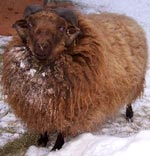
Help Save Buster The Purebred Shetland Ram
permanent link to this entry
Mon, 12 Feb 2007
Savvy Vegetarian is proud to host the 64th Carnival of the Green
COTG is a roving digest of the green blogosphere, managed by Treehugger - with a sustainability focus as opposed to green politics in general. Just like a regular carnival it roams around offering a sample of its world.
Last weeks Carnival of the Green was hosted by Nonoscience. Look for next weeks' show at Jen's Green Journal
At this weeks Carnival we toss the word sustainable around like lettuce; we use 'eco' and 'green' in the same sentence; we're food obsessed environmentalists; climate change is still the buzz; and carlessness is creeping up on us.
Sox First: The Exxon Mobil funded think tank the American Enterprise Institute was bribing scientists to deny the findings of the Intergovernmental Panel on Climate Change report released last week. Quel surpris!
Mindful Momma reminds us to go see Al Gore's 'An Inconvenient Truth' - now out on DVD and video, so no excuse.
According to Jake at Real Green Tips: At this point, carbon sequestration remains a questionable way to fight global warming. His post includes a list of Carbon Offset Projects from around the world.
Thoughts From Kansas, posts a thoughtful article and deep discusssion about Carbon Tax, including the view from The Other Side.
Sludgie waxes satirical and sardonic
while sending up Nicole Ritchie, the
IPCC Report on Climate Change, and the presidential response to the findings.
Get the scoop on the IPCC Report at Grist.
Evangelical Evangelist: "Will the global warming global concert "SOS" become nothing other than a global church service with millions of worshipping faithful, resplendent with choirs, paying of penances, and heaps of fire and brimstone from a shiny-suited, sweaty, purple-faced Al Gore in the pulpit?"
Sarah Rich of World Changing writes about local farmers reversing desertification in Sahel, Niger. By following simple strategies, such as letting baobob trees grow instead of cutting them down, they've crossed the thin line separating starvation from subsistence. Also at World Changing, see Branson's "Virgin Earth Challenge" about the joint announcement from Sir Richard Branson and Al Gore of a $25 million prize for viable solutions for carbon sequestration.
The Disillusioned Kid pushes everybody's buttons with his essay, 'Fair's Fair'. DK thnks the popular green idea that individual actions can bring about significant social economic change is a futile notion, playing right into the old capitalist system, while organized and sustained collective activity really gets the job done.
Cityzen Jane plays 20 questions about your relationship with nature - having to do with sustainability. Answer them the fun way - link to her YouTube video.
Fish Creek House, Montana's green B &: B: Sustainable foodie GP Stone discusses Michael Pollan's recent food article in context of green innkeeping.
Greenthinkers features their favorite Canadian scientist, David Suzuki, sounding off about bottled water - "it's absolutely disgusting that people are so uncertain about their water that we buy it, paying more for bottled water than we do for gasoline".
Walking the talk with Moritherapy and her friend Aaron: "today, it�s harder to differentiate cars from SARS � massive mechanical ants that suck out the resources. they pollute in exchange for a blind convenience � no longer just a useful tool, the car menaces us, threatens our existence, and still we drive."
Rachel App gives practical advice on How To Live Without A Car In A City, She explains, for the sceptics, how your life will actually improve from doing so.
The Outspokin' Cyclist: Ice puts focus on need for different kind of cities. You guessed it - ones without cars!
Silicon Valley Blogger presents Borrow, Barter, Buy Used: Espousing The Frugal Lifestyle posted at The Digerati Life. Everything depends on your point of view! I thought I was poor - turns out I'm actually frugal, which sounds much more like a choice.
Three From Groovy Green:
Review of Nourishing Traditions
"What you eat has a bigger impact on how you feel than you might imagine."
Aero Garden Video Review
"It's a kitchen appliance for those that a.) love gadgets and b.) want to grow some basic herbs or
veggies without much fuss or mess."
Eco Fashion Q&A;: Who�s Got Green Jeans?
"Researching companies for this post, I easily complied a list of over 30 brands!"
Miss Malaprop's indie finds for your uncommon life has discovered sustainable lingerie (NOT underwear). for our delectation, AND eco friendly shopping bags - beautiful, economical, light and scrunch up to fit in a purse or pocket, which is shockingly convenient!
Welcome To Ecofashionistas: Urth.tv 's Eco-fashionista Blogger, Rowan Gabrielle, reports from the Paris Fashion Week on the amazing selection of eco-fashion designs. Some of her favorites include Make Piece's wool products, Veja Trainers' sneaker and shoe line, and Nahui Ollin's bags and accessories made from recycled wrappers.
Victoria E: Sneak preview of organic cotton clothing company Twice Shy's Spring 2007 collection. The only gripe I have about kids organic cotton clothing is that it never has sizes for children over four.
Marie at Green Fertility: describes in detail the evilness of parabens in our shampoos (the 'poo' in 'shampoo') and other body care products, making us fat, and giving us cancer. Fortunately, she gives us a list of paraben free products and alternatives, such as apple cider vinegar and castile soap.
Hip and Zen Pen reviews Novica, a truly great, huge and well-organized site featuring hand-crafted fair trade gifts from global artisans - everything from rugs to knick knacks. I've visited Novica before, and loved it - thanks for spreading the word, Alisa.
What's So Bad About Disposables? Bean Sprouts Melanie Rimmer tells us exactly what's so bad in the most recent of her February challenge series, 'Ditch the Disposables'. Hands up anyone who has not used any of these in the last year: disposable diaper, paper towel, sanitary napkin, tissue. Uh-huh! Just as I thought. And what about TP? You see why this is a challenge!
Organic Researcher has an excerpt from Michael Pollan's article 'Unhappy Meals' posted at The Digerati Life. Not clear, but I think likely taken from MP's book, The Omnivore's Dilemna, in which MP finally figures out that meat is bad for the environment. His solution is to eat less meat and more veggies, which I agree is a good start.
What is it about Valentine's Day, the overblown commercial hoo-ha, that sucks us in? Are we hopeless sappy romantics? Or just addicted to chocolate? Great Green Goods has numerous links to charming, original ecological and fair trade valentines gifts. Better late than never - you can always bookmark for next year.
Celebrate V Day organically, sustainably, and non-commercially. Make your lover a gorgeous, healthy Valentine's Salad from Organic Authority. Guaranteed to bring you true love.
If you're going to go wild and marry your true love, Hippy Shopper can tell you how to have a green wedding. Not necessarily an inexpensive or sane one. Here's my advice - have a DIY wedding for under $1000, then an extended eco honeymoon (to recover from the wedding), or make a down payment on a house that's in need of greening (aka fixer-upper), or donate a fistful of dollars to your favorite sustainable cause.
Veggie Revolution: Read about the National Wildlife Federation's new proposal to help farmers grow native grasses for biofuels, an initiative that will help wildlife and help to slow global warming.
Shark Alliance: Alexandra Cousteau introduces the newly-launched Shark Alliance and talks about how tens of millions of sharks a year are still killed for shark fin soup.
Everyday Trash: Leila Darabi's interview with surfer photographer Andy Hughes, who photographs beach debris, got great response. Hughes hopes his book, 'Dominant Wave Theory', will help consumers "consider and ponder the consequences of our mass consumerism."
Jen's Green Journal: posts about the 'unbelievable' opposition to the planned Divine Strake nuclear test in Nevada, from conservative mainstream TV news, ABC 4. The mushroom cloud would drift over Utah, and for once, nobody believes the government when they say it's not going to harm anyone.
Sustainablog: Poop Beneath Your Feet: A Good Thing? ponders what to do with the fibers left after converting lagoons full of cow manure into liquid methane gas. Some bright lights thought of making fiber board flooring. Apparently it hasn't occured to them that if there weren't millions of cows in CAFO's, we wouldn't have to contemplate the possibility of walking on their waste. Go Veg!
Treehugger has so many posts each day about so much important green stuff, that I can't pick one to feature - just go there and (try to) read them all. And subscribe to their newsletter, while you're at it.
Savvy Vegetarian's New Year's Resolution: Avoid GMO's Like The Plague That They Are. I know it's February already, but this is actually a life long resolution.
Thanks for visiting Carnival of the Green! See you next week at Jen's Green Journal.
permanent link to this entry
Wed, 24 Jan 2007
Fair Trade Chocolate For Your Valentine

|
Renee of A Greater Gift - SERRV International* - asked for a mention of their fair trade chocolate for Valentine's Day. I said yes (Fair Trade is dear to my heart, right up there with Buy Local Organic), and she offered me chocolate. I was going to wait on this until I actually got my Divine Fair Trade Chocolate in the mail, but I figured, the sooner the better, so you'd have time to order for Valentine's Day.
*"SERRV International is a non-profit organization, which works with thousands of small-scale artisans and farmers in Africa, Asia, Latin America and other developing regions of the world by marketing their handcrafts and agricultural products. Working with 90 community-based organizations in 34 countries, SERRV creates economic opportunity so these producers can support their families. In addition to purchasing and marketing products, SERRV works with producers to assist them in becoming economically self sufficient through product design, training, information, technical assistance and market access."
permanent link to this entry
Sat, 06 Jan 2007
New Year's Resolution: Save Your Health AND The Planet - Avoid GMO Foods Like The Plague That They Are
From
Spilling The Beans Newsletter, Jan 2007:
Consumers can improve their health with one New Year's resolution. "Avoid eating GMOs (genetically modified
organisms)," says GMO expert Jeffrey M. Smith, author of
Seeds of Deception.
"Smith urges consumers to cross off brands that contain genetically modified (GM) ingredients, which are in 60-70% of foods sold in the U.S. The principle offenders are non-organic soy and corn derivatives and canola and cottonseed oils. Thus, Ragu tomato sauce would be off limits, since it contains corn syrup and soybean oil, but Light Ragu or Barilla brand sauces, which contain olive oil and no corn sweetener, are non-GMO."
"Consumers in the U.S. are being used as human guinea pigs by biotech companies, which rushed their GMOs to market without adequate studies and before the science was ready," says Smith. "Once Americans learn they are feeding these high-risk foods to their children, they will demand non-GMO alternatives." In Europe, where consumer knowledge about GMOs is considerably higher, shoppers' concerns prompted food manufacturers there to remove all GM ingredients. Smith sees this trend building in the US, with more and more healthy brands declaring ingredients "Non-GMO" on the label.
"The FDA�s recent announcement declaring milk and meat from cloned animals as safe," says Smith, "reminds us of their 1992 approval of GM crops. When the agency's internal files were made public years later, they revealed that the FDA�s GMO policy was dictated by corporate manipulation, not sound science. Warnings by government scientists were ignored by political appointees from the biotech industry." Smith adds, "And like GMOs, the FDA does not want labels on cloned food, thereby forcing the entire population into their dangerous uncontrolled experiment."
Visit Responsible Technology for tips on avoiding GMOs at home and in restaurants.
Preview the video Hidden Dangers in Kids' Meals
permanent link to this entry

New Recipes
SV Articles:
Savvy Veg Advice
New Blog Posts
Free SV Reports!
Testimonials
"Wow, thank you so much for your input, it was very thorough and more than I expected. You rock! :)"
"I see you are passionate about this, that is why I know I came to the right person for advice."
"Thanks for the great advice Judy! You're a life-saver!"
"Thank you for your reports and encouragement ...all very much appreciated!"
"I saw lots of vegetarian sites, and yours was one of the best."
"Your email has given me some peace. This is who I am and I'm not going to fight against it anymore."